
Technology Review: Pin vs Surface Type Meters
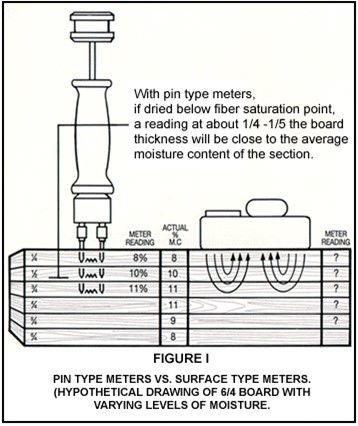
Without question, pin-type meters are the only sure way to obtain three key pieces of information quickly and accurately: the moisture gradient (the difference between the shell and core moisture), an estimate of the average moisture content, and the range of moisture content. Simply put, pin-type meters are the only kind of instrument that tells you what’s really happening inside a board or a piece of wood. Pin-type meters operate on the principle of electrical resistance; they use the wood as an element in a circuit by driving two pins or electrodes into it. This method works because moisture is an excellent conductor of electricity and dry wood is an effective insulator.
The electrical resistance method for determining moisture content had been around for years but became fully accepted by industry in the late 1940’s, when Delmhorst introduced its ram-type electrode with two insulated pins. The 26-E electrode has been copied by most manufacturers from Europe to Japan, and is the key to accurate moisture content tracking. Without it, you just can’t do the job properly, no matter how sophisticated the electronics used to generate the signal.
Since there can be significant differences in the distribution of moisture within the same board, particularly during the drying process, why leave the quality of your work to chance. Pins on electrical resistance meters can be insulated or non-insulated. Insulated pins have insulated shanks so that only the tips are exposed. The pins make contact with the wood fiber only at their uncoated tip and provide much more accurate readings of moisture content at various levels of penetration. Knowing that the board is not uniform, you can use the pins to determine the drying pattern: Is there a gradient? Is it a reverse gradient? Are there water pockets?
There are other ways to measure moisture content, but no other technology can give you so much information quickly on average, range, and distribution like pin-type resistance meters can. Not the oven test. Not even the so-called “new” electromagnetic wave technology, which is actually based on the old principle of radio frequency. These meters have a non-penetrating surface electrode. They produce readings that are a biased response to the moisture closest to the source of the magnetic field, in this case, at the surface. The signal weakens with increasing penetration. It’s virtually impossible to obtain a true average of a cross-section because this technology cannot differentiate between surface and core moisture. In other words, surface meters are ineffective when evaluating a board’s overall moisture distribution. Surface meters cannot tell you if moisture content is uniform or if there is a gradient and what the gradient slope is. They are also affected by the presence of other non-wood materials in the area of the field.
With pin-type meters, you do have to take the time pre-drill or punch the holes and insert the pins, next sealing the holes, but in assuring quality, there are no shortcuts.