
Non-destructive Moisture Detector for EIFS
Tramex Wet Wall Detector
A Tramex Wet Wall Detector is a non-destructive moisture detector for EIFS. The non-intrusive testers are typically not accepted in legal proceedings.
The detection, evaluation, and accurate locating of excess moisture in substrate beneath exterior insulation finish systems can be difficult, costly, and time consuming and can involve the inspector making a large number of holes in the EIF system. With this in mind, Tramex has developed a new, non-destructive, moisture meter, the Wet Wall Detector.
The Wet Wall Detector has been specially developed for the detection, location, and tracking of excess moisture within and behind EIF systems. This electronic instrument will read through fiber-reinforced lamina and exterior insulation to locate and evaluate excess moisture that may be present in the sheathing substrate and wood stud. The Wet Wall Detector is the latest, most practical, and useful moisture meter you can have when conducting a moisture survey on buildings with EIFS claddings.
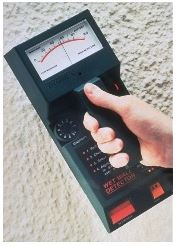
- For non-destructive moisture evaluation of EIF systems.
- For tracing moisture back to source.
- Fast and easy to operate.
- Instant clear readings.
- Light-weight hand-held and battery operated.
- Inexpensive to purchase and operate.
The Wet Wall Detector is designed and manufactured by Tramex who have been producing a range of moisture measurement and detection instruments for construction material since 1980. Also, available are moisture scanners to measure moisture content of the drywall on the inside of the house.
THE PROBLEMS OF EXCESS MOISTURE IN EIF SYSTEMS
By visual inspection, the location of excess moisture and decay behind an EIFS wall cladding systems can be difficult and near impossible to detect evidence of this moisture and decay are not visible on either side of the wall. Excess moisture can be hidden and trapped in the substrate and within the thickness of the wall. If these conditions are allowed to continue, the moisture will increase as will the rot and decay, eventually leading to possible failure of the cladding system and the structure. Also, wet insulation loses its thermal value resulting in unnecessary heat loss or gain and thermal movement in the structure. So, in the interest of all concerned, early detection of these problems, or potential problems, and corrective remedial action makes good economic sense.
HOW DOES THE WET WALL DETECTOR WORK?
The Wet Wall Detector is an electronic handheld moisture detector working on the principle of electronic impedance. With impedance measurement, harmless signals are transmitted from the electrodes, at the base of the instrument, deep into the thickness of the wall. These signals measure the change in electronic impedance, which is translated into a relative moisture content reading and instantly displayed on the clear large analog dial. Readings are instant and continuous. The Wet Wall Detector is also fitted with an audible device that sounds at high readings.
The Wet Wall Detector will give vital information necessary to evaluate and carry out moisture assessment on the condition of most fiber reinforced EIF systems of wall cladding and similar systems at an affordable cost without complications.
THE FAST NONDESTRUCTIVE WAY TO DETECT EXCESS MOISTURE
Tramex Wet Wall Detector has been specially developed to aid in the detection, location, and tracing of excess moisture within the cladding, the sheathing, and the wood stud on EIF systems.
The Wet Wall Detector is nondestructive in operation. This means that it can detect excess moisture without the need to mechanically probe, cut, or damage the surface.
The Wet Wall Detector’s low frequency electronic signal can read through the glass fiber reinforced lamina and insulation deep into the substrate. It is easy and fast to use, light to carry, and can be operated with one hand. Having detected the excess moisture the Wet Wall Detector can be of great benefit in tracing this moisture back to its point of ingress or source.