
Drainage EIFS
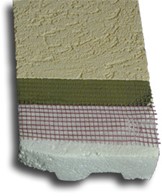
Moisture Drainage EIFS is a polymer-based system introduced in 1996 to be used in applications when moisture may enter the wall from improper flashing, leaking windows, inadequate sealants. It is a more “forgiving” system for EIFS applications lacking proper details, and job supervision. MD-EIFS is required over all moisture sensitive substrates for residential construction by the model code authorities.
Drainage EIFS contains the following components:
- Drainage plane such as Tyvek, felt paper, or a liquid applied air barrier coat applied to the substrate.
- Drainage mat, or vertically grooved 1-lb (cu. ft.) EPS, or vertically beaded adhesives.
- Originally, mechanically fastened but these system have evolved and all manufacturers have an adhesively attached system at this time.
- Accessories for starter track with drainage holes, special window tracks and flashings.
- Fiberglass reinforcing mesh embedded in a base coat.
- Textured acrylic finish.
Drainage EIFS has the following typical characteristics:
- As the illustration on page 6 of this topic indicates, water enters at the top and drains out at the starter track trim. Water is channeled downward by a water-resistant barrier.
- Has all the design features of an EIFS “barrier” system.
- Generally requires no control joints for lamina expansion and contraction (unlike PM systems.)
Drainage System Components
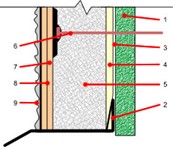
- Substrate
- Perforated Drainage Trim
- Moisture Barrier Membrane
- Drainage Layer (either separate or incorporated into the grooved EPS), or vertical notched trowel base coat application.
- Proprietary Insulation
- Mechanical Fastener (usually no adhesive)
- Basecoat
- Mesh
- Finish
Residential Drainage System
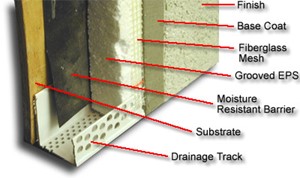
Residential Drainage with Grooved EPS
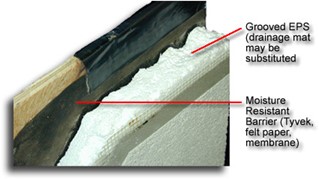
Total wall MD-EIFS with Drainage Wrap
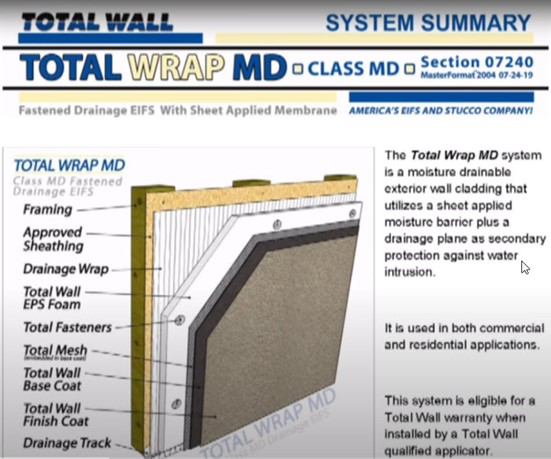
Detail components of Total Wall.
The most common MD-EIFS now uses a Liquid Membrane & adhesive applied with a notched trowel.
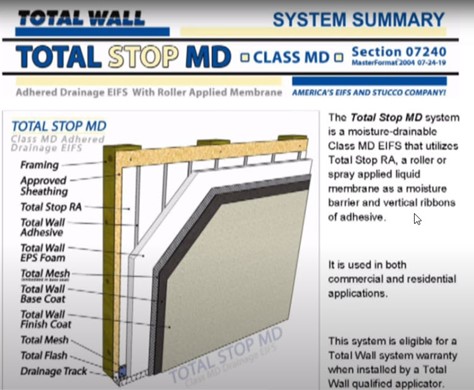
Detail components of Total Wall.