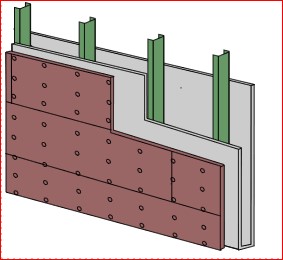
Standard Insulation Board for Polymer Based EIFS
Insulation Boards are the building blocks of an EIFS system. Besides allowing a low cost creative architectural design, it is also energy efficient. EIFS creates an envelope of exterior insulation that reduces thermal bridging and allows for expansion and contraction while maintaining integrity of the finish.
The PB EIFS and MD-EIFS clad buildings contain the following insulation board:
1 lb. per cubic foot of expanded polystyrene (EPS).
- Generic requirements:
- Manufactured from virgin beads (granules about the size of grains of sugar)
- Aged or cured to remove all moisture prior to cutting: 6 weeks air dried or 5 days in kiln.
- + or – 1/16 inch in thickness
- + or – 1/16 inch square (measure diagonals to verify)
- Maximum size: 2′ X 4′
- Maximum thickness: 4″
- Minimum thickness: 3/4″
- The proper designation for EPS used in PB EIFS is Type 1.
- The maximum flame spread for EPS is 25 and the maximum allowable smoke development is 450
- Inspection considerations:
-
- EPS must be protected from direct sunlight. Ultraviolet (UV) causes the EPS to yellow which is evidence the EPS on the surface has been reduced to dust. All yellow EPS MUST BE RASPED TO REMOVE UV damage, prior to application of the base coat.
- EPS must be staggered at the outside corner to maintain a straight line.
- All gaps greater than 1/16″ between pieces of EPS MUST be filled with slivers of EPS or EIFS manufacturer approved spray foam. Gaps filled with adhesive are likely to crack at the board edge because of differences in the coefficient of thermal expansion between the EPS and the base coat.
- EPS must have the certification by the testing laboratory, required by the building codes. Evidence may be:
(a) Stamped edges of EPS board
(b) Printed on the bag
(c) An accompanying letter from testing lab - Entire surface of EPS must be rasped to insure a good bonding surface and remove surface imperfections prior to application of base coat and mesh.
- EPS board edges should not align with window or door corners. (This is covered again in the Details Lesson.) If EPS does align it is likely to crack at the corners.
- EPS board joints must offset sheathing board joints a minimum of 6″.
- EPS at expansion joints should be spaced apart enough to allow for the thickness of back wrapping (1/16″ per joint interface), so finished joint is the proper width
Other Types of Insulation Board
- Styrofoam (Dow “blue” board) is extruded rather than expanded and is usually 1.8 – 2.2 lb. cu ft. It is often used with PM (polymer modified systems) or one coat stucco systems.
- Polyisocyanurate rigid insulation (usually tan in color), used as sheathing and the coatings direct applied, is generally 2lb. cu. ft. density. If exterior sheathing is omitted, codes require a minimum of 1/2″ interior gypsum sheathing as a fire barrier.
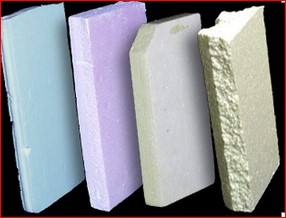
Dow ‘blue’ board styrofoam – extruded styrene (1.8-2.2 lb/cu/ft density)
Rigid extruded styrene (1.8-2.2 lb/cu/ft density)
Polyisocyanurate rigid insulation (1.6-2.5 lb/cu/ft density)
Moulded polystyrene EIFS board (1 lb/cu/ft density)
General Comments
- The majority of existing EIFS homes and most commercial projects, both new and existing, contain EPS as the insulation board. The newer “drainage systems” still incorporate standard EPS with a drainage mat, grooved EPS or a wet applied moisture/air barrier. In drainage systems, the EPS was generally mechanically fastened (see Fastener Topic in this Lesson). EPS, when adhered, was generally categorized as a component of a “barrier system.” However, drainage systems developed after 2000 are typically adhered using a notched trowel with grooves vertical. The adhesive is applied with a notched trowel to the back of the EPS, not to the wall. Older barrier EIFS projects may have had adhesive applied horizontally and, prior to 1990, may have been installed using the “ribbon and dab” method or pattern of adhesive to the back of the EPS. EPS works well with the EIFS systems because of its lack of structural strength which acts like a buffer or continuous expansion joint for the structure. The lamina (base, mesh, finish) is strong enough to contain the EPS, which is capable of expanding and contracting more than any other building components. The individual beads literally collapse within themselves without transferring stress to the lamina.
- The key to a quality EIFS application is that the EPS be properly installed, rasped, and gap-free. Without a good foundation the rest of the system is vulnerable to long term failures.
Layout and Attachment of Insulation Board
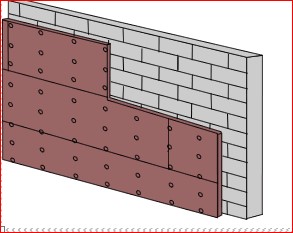
Fastened to Masonry Walls
Fasteners spaced 8″ (203mm) o.c. vertically, and 16″ (406mm) o.c. horizontally.
Fastened to Stud Walls
Studs 16″ (406mm) o.c. horizontally with fasteners spaced 12″ (305mm) o.c. vertically.
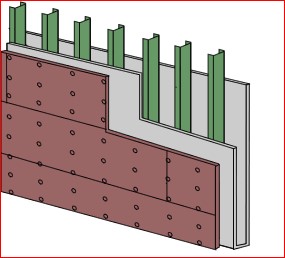
Fastened to Stud Walls
Studs 24″ (610mm) o.c. horizontally with fasteners spaced 8″ (203mm) o.c. vertically.
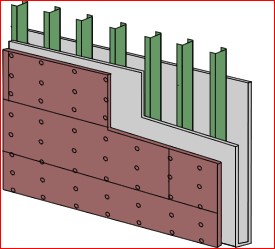
Fastened to Stud Walls
Studs 24″ (610mm) o.c. horizontally with fasteners spaced 8″ (203mm) o.c. vertically.