
Hard Coat Stucco Systems (HCS) includes Traditional Three-Coat-Stucco and One-Coat-Stucco (OCS)
- Require specific design patterns for control joints and expansion joints.
- Lower costs are associated with the products used in HCS systems.
- Provide excellent surface damage resistance.
- HCS is growing choice both in residential and commercial construction.
Components of HCS include:
- “OPTIONAL” FOAM UNDERLAYMENT
- VAPOR RETARDER OR MOISTURE BARRIER – Check Manufacturer Specifications – Check Local Building Code
- 1″ 20 ga WIRE OR 1 ½” 17 ga OR #2.5 GALVANIZED METAL LATH (#3.4 galvanized Metal Lath usually used in ceiling systems)
- METAL TRIM ACCESSORIES – Casing Bead – Expansion Joint – Corner Bead – Inside Corner Bead
- POLYMER MODIFIED STUCCO MIX IN A BAG APPLIED TO 3/8″ – 1/2″ THICKNESS – Mix with Only Water and Sand – Check with Manufacturer for approved admixtures that decrease curing time, improve workability and resistance to cracking, etc.
- FINISH COAT
Three Coat Stucco Typical Wall Section with Metal Lath
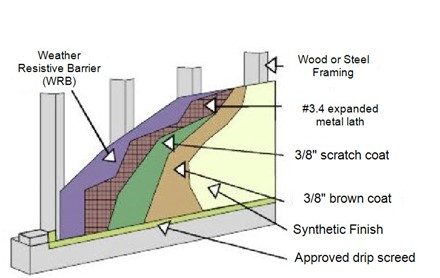
This drawing shows how OCS is applied with stucco netting.
One Coat Stucco Typical Wall Section With Stucco Netting
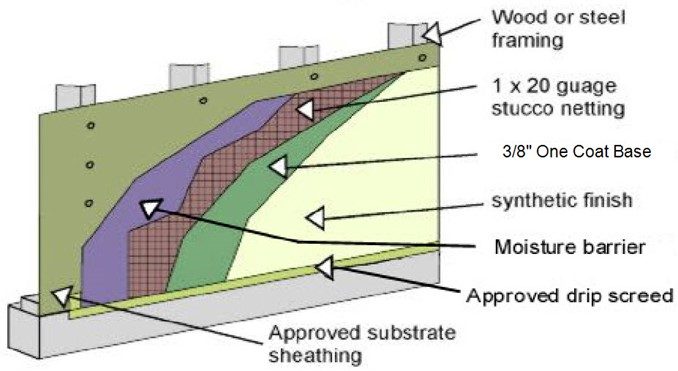
This drawing shows how OCS is applied with stucco netting.
OCS Foundation Termination
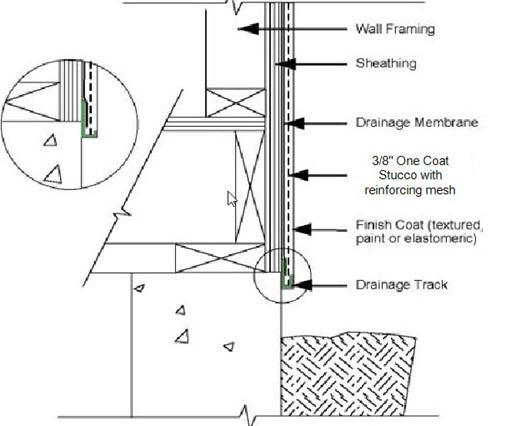
This is showing the proper use of Drainage Track. Note the enlarged detail view.
The Hard Coat Stucco System consists of 2 or 3 coats and can be applied over virtually any type of wall construction, new or retrofit. The Hard Coat Stucco System can be applied as follows:
- One Coat Stucco: 2-coat application for a total of 3/8″minimum thickness base coat and a finish coat applied over a vapor barrier and minimum 20 ga stucco netting or expanded metal lath attached over solid backing. (i.e.: foam board, plywood, exterior gypsum sheathing, fiberboard.) OR
- Traditional Three Coat Stucco: 3-coat application consisting of 3/8″ scratch coat, 3/8″ brown coat and a finish coat applied over a vapor retarder and expanded metal lath attached to framing. NOTE: 3-coat method may be applied directly to open framing. However, stucco cracking is better controlled when sheathing such as foam board, plywood, exterior gypsum sheathing or fiberboard is applied to the framing members and stucco to buffer the expansion, contraction and warpage that occurs in wood or steel framing.
Expansion joints in the Three Coat Stucco System provide expansion relief through the substrate. Control joints provide expansion relief in the coating only.
- Expansion joints are required: At structural expansion joints. At the abutment of dissimilar materials.
- Control joints are required:
- At corners of doors, windows, or any wall openings.
- At floor lines in the frame construction. In frame construction to create panels no larger than 144 square feet. Maximum distance between joints not to exceed 12′ in any direction. Length to width ratio not to exceed 2-1/2 to 1.
Where aesthetic reveals are desired in coating, pre-formed trim or accessories may be used. Where architectural moldings, copings, or popouts are desired, foam shapes with Stuc-o-lite coatings may be used. When using wood sheathings:
- Provide minimum 1/8″ gap between sheets to allow for swelling of sheathing.
- Avoid sheathing joints at floor lines in multi-story construction.
When the Three Coat Stucco System is applied to horizontal areas where standing water might occur, a minimum 6″ on 12″ slope is recommended. Sealing of cementitious finishes prior to painting or finish application is recommended to prevent efflorescence. Sealant and foam backer rod for all details must be compatible with the Three Coat Stucco System. Consult system manufacturer for information concerning applications and approved sealants.