EIFS Restoration Guide
This section is intended to provide installation and field testing instructions for sealants, coatings, and primers for EIFS applications in order to provide building owners the longest lasting weatherproofing system available.
Introduction
We thank Dow Corning for their efforts to supply this course with complete information on the use of their sealants and systems for use with EIFS. Other manufacturers can provide similar information. Be sure that the sealant system that you use is approved by the EIFS manufacturer.
The purpose of this guide is to discuss why and how to use Dow Corning brand sealants, Dow Corning 123 Silicone Seal and Dow Corning AllGuard Elastomeric Coating for the restoration of Exterior Insulation and Finish Systems (EIFS) and joints within or adjacent to the EIFS. Rather than a temporary fix, the Dow Corning EIFS Restoration System offers long-term waterproofing solutions to leaking EIFS buildings.
The recommendations in this guide are not intended to replace those of a qualified industry consultant or engineer who can investigate and evaluate the existing condition of a particular EIFS building. Problems associated with EIFS can be complex and may not be repaired through improved waterproofing of the building facade alone. Water penetration through faulty joints or at terminations of the EIFS may cause substantial damage in the EIFS or the underlying structure that must be addressed separately from the waterproofing. Addressing certain design flaws such as the failure to allow proper water drainage from a window system, overheating of expanded polymer styrene (EPS) insulation, or excessive deflections due to poor foundations are beyond the scope of this document.
SILICONES ARE BETTER
- Dow Corning one-component silicone sealants do not require special mixing, unlike multicomponent polyurethane sealants.
- Dow Corning silicone sealants have been tested and recommended by most major EIFS manufacturers for use with their systems.
- Dow Corning silicone sealants are UV stable and do not degrade in outdoor weathering. Silicone sealants have a life expectancy of greater than 20 years compared to 5 to 10 years of life expectancy for many organic polyurethane sealants
- Dow Corning 790 Silicone Building Sealant, the preferred sealant for EIFS expansion joints, has unparalleled ultra-low modulus properties, movement capability of +100/-50 percent and a proven 20+ year performance on buildings.
- Inorganic silicone sealants have more stable modulus and remain flexible in cold temperatures as compared to organic polyurethane sealants that stiffen in cold temperatures.
EIFS Joint Failure Overview
Because EIFS joints may fail for several reasons, the failure mode of the sealant joint should be examined to determine which restoration method is feasible or preferred. The following sections describe the four basic types of sealant joint failures and their possible causes.
ADHESIVE FAILURE OF SEALANT
Adhesive failure is a loss of bond or adhesion of the sealant to a substrate. This failure may occur for three primary reasons: improper use of primer, failure to use a primer, or improper surface preparation. If field adhesion testing had been performed at installation, the results should have dictated surface preparation requirements. Most sealants require the use of a primer. If testing indicates that a specific primer should be used, failure to use that primer or improper use of the primer may cause adhesive failure.
Adhesive failure may also be the result of an improperly prepared substrate. The substrate must always be clean, dry, and frost-free prior to sealant installation. Adhesion may be reduced if the EIFS coating is not fully dry. An improperly prepared substrate is a common source of adhesive failure of sealant in a joint.
SEALANT DETERIORATION
Up until the past several years, multicomponent polyurethane sealants were used on most EIFS buildings. Polyurethane sealants were used on most EIFS buildings. Polyurethane sealants are organic materials that deteriorate in the presence of ultraviolet light. This deterioration manifests itself in loss of sealant flexibility and movement capability, or in some instances, reversion of the sealant from a cured to an uncured state. It is not uncommon for polyurethane-sealed joints to experience sealant failure within 5 to 10 years. Total sealant deterioration or reversion of a polyurethane sealant is one of the most difficult joint failure modes in EIFS to restore.
COHESIVE FAILURE OF SEALANT
Cohesive failure occurs when a sealant tears or splits within itself as a result of joint movement. Cohesive failure is usually the result of the sealant no longer being able to accommodate the expansion and contraction of the joint. A sealant is expected to have a certain movement capability as determined by the sealant manufacturer. Sealants are either designated by categories of +/- 12-1/2 percent, +/- 50 percent, or +100/-50 percent initial movement capability. However, many polyurethane sealants will stiffen and show a loss in movement capability over time. As a result, joint movement may cause cohesive failure of a stiffened sealant.
Joint movement on a percentage basis is also affected by the size of the joint. For example, 1/4″ movement on a 1/2″ wide joint will be twice as much on a percentage basis as a 1/4″ movement on a 1″ wide joint. Therefore, narrower joints are more prone to cause failure of the sealant.
Cohesive failure may be the result of the sealant joint profile. The ideal joint profile might be viewed as the compromise between two undesirable extremes. Lesser sealant depth allows for greater movement capability of the sealant, but because organic sealants may degrade on the surface, the joint is susceptible to cohesive failure. Thicker sealant depth ensures compensation for weathering of the sealant surface but reduces sealant movement capability and increases the potential for joint failure.
DELAMINATION OF THE EIFS COATING
Excessive sealant depth will reduce movement capability of the sealant, increasing the potential for substrate failure.
Delamination occurs with the sealant overstresses the coating. This can happen at any time, but is particularly prone to occur when the EIFS coating is softened by prolonged exposure to moisture or water. Delamination of the EIFS coating can often be attributed to the incorrect use of the open cell polyurethane backer rod. The absorptive nature of the open cell polyurethane backer rod allows moisture to continuously contact the EIFS coating causing softening of the EIFS coating and increasing the potential for delamination during joint extension. EIFS requires the use of closed-cell polyethylene or non-gassing polyolefin backer rods to perform successfully.
Until recently, EIFS manufacturers specified that their acrylic finish coat be applied into the joint. This coating is particularly vulnerable to softening when wet, and as a result, finish coat delamination is a common source of EIFS joint failure. EIFS manufacturers now require that the finish coat be stopped at the face of the joint and that the sealant be applied to the more moisture-stable basecoat. Both the basecoat and color primer are more stable in a wet environment and are less susceptible to delamination when stressed by a sealant during joint extension.
The other significant factor contributing to EIFS coating delamination is the modulus or stiffness of the sealant. As previously discussed, some sealants, and especially some polyurethane sealants, stiffen with age. A polyurethane sealant that may initially be low modulus might become noticeably less flexible after weathering.
Products for EIFS Restoration
SILICONE WEATHERPROOFING SEALANTS
Dow Corning 790 Silicone Building Sealant is the premium expansion joint sealant for EIFS. With ultra- low modulus, high movement capability of 100/-50 percent, Dow Corning 790 Silicone Building Sealant can perform in joints where other sealants would fail. This sealant is intended for EIFS-to-EIFS joints and requires the use of a Dow Corning primer for all EIFS applications. Consult the Dow Corning Weatherproofing Sealant Guide for specific EIFS systems tested and approved. Dow Corning 790 Silicone Building Sealant is available in eleven standard colors and pre-matched custom colors for EIFS.
Dow Corning 791 Silicone Perimeter Sealant is a low cost, high-performance sealant intended for EIFS-to-metal application and expansion joints with certain EIFS systems. This sealant features +50 percent movement capability and primerless adhesion to most EIFS manufacturers’ systems. Dow Corning 791 Silicone Perimeter Sealant is available in five standard colors.
Dow Corning 795 Silicone Building Sealant is a high performance sealant intended for use at EIFS perimeters and certain EIFS expansion joints. The sealant features excellent primerless adhesion to most EIFS systems. Dow Corning 795 Silicone Building Sealant is available in eleven standard colors and pre-matched custom colors for EIFS.
Since EIFS manufacturers do not permit the use of open-cell polyurethane backer rod with their systems, use either Dow Corning 791 Silicone Perimeter Sealant or Dow Corning 795 Silicone Building Sealant in joints where the EIFS is adjacent to nonporous or meter surfaces.
PREFABRICATED SILICONE SEAL
Dow Corning 123 Silicone Seal is the key product in the Dow Corning’s EIFS Restoration System. This pre-fabricated silicone strip, when used in conjunction with Dow Corning 795 Silicone Building Sealant as an adhesive and Dow Corning AllGuard Elastomeric Coating, provides a low cost, long-term waterproofing system for EIFS buildings. The ultra-low modulus Dow Corning 123 Silicone Seal, which features movement capability of +200/-75 percent, produces minimal stress of an EIFS finish coat (3 psi at 25 per- cent elongation), and is available in five widths: l”, l-1/2″, 2″, 3″, and 4″. Dow Corning 123 Silicone Seal is available in six standard colors and pre-matched custom colors for EIFS.
WATERPROOF COATINGS
Dow Corning AllGuard Elastomeric Coating is a 100 percent silicone latex water-based elastomeric coating intended for the waterproofing of masonry, stucco, and EIFS buildings. Unlike acrylic elastomeric coatings, Dow Corning AllGuard Elastomeric Coating offers the long-term weatherability and flexibility of Dow Corning silicone sealants. Available in eight standard and custom colors, Dow Corning AllGuard Elastomeric Coating, when used in conjunction with Dow Corning 123 Silicone Seal, offers unlimited color flexibility in waterproofing an EIFS building.
PRIMERS
Dow Corning 1200 Prime Coat is a solvent-based, adhesion-promoting primer intended to be used with Dow Corning sealants. Dow Corning 1200 Prime Coat is compatible with EIFS and can also be used on adjacent metal, if priming is required. Dow Corning 1593 Cleaner/Primer is a VOC-compliant alternative to Dow Corning 1200 Prime Coat that can be used as a cleaner for the EIFS and adjacent metal surfaces. Dow Corning 1593 Cleaner/Primer is compatible with EIFS and is intended for us with any Dow Corning sealant.
EIFS Restoration Methods
Four restoration methods are offered for the repair and restoration of EIFS and EIFS joints. Any of the four methods may be appropriate for your specific building. The failure mode of the existing sealant joint will help to dictate which is the most cost-effective and practical restoration method. Mockups of the selected methods should be installed to help determine appropriateness of each repair method. Dow Corning will assist you in helping you make this determination. Certain restoration methods will require the assistance of an EIFS manufacturer. Following is an overview of each restoration method and a discussion of the advantages and disadvantages of each method. The following section includes the specific procedures for each restoration method.
RECESSED JOINT
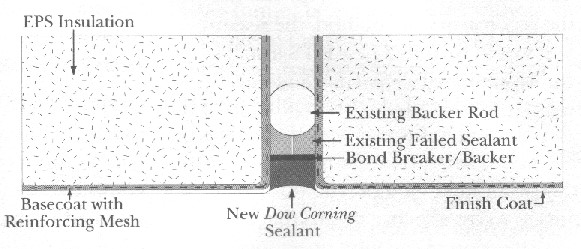
In situations where the failed existing joint has been recessed into the joint, it is possible to Install a new sealant joint over the old sealant joint without removing the failed sealant. The existing sealant must be recessed at least 1/2″ from the face of the joint to allow a new sealant joint to be installed. Recess of greater than 1/2″ may allow a closed-cell backer rod or foam tape to be installed. Slit the existing sealant before applying a bond breaker tape over it in the joint.
The advantage of this method is that the joint can be made watertight without changing the appearance of the joint. Also, this method is fairly cost-effective since removal of the old sealant is not required. A potential disadvantage of this procedure results from the finish coat having likely been installed into the joint. Any new sealant will probably be installed to the finish coat unless the additional step of removing the finish coat of the EIFS is performed. Dow Corning sealants have excellent adhesion to both finish and base coats of EIFS. While Dow Corning is not responsible for the integrity of the EIFS coating and potential delamination of the EIFS coating under stress, the use of a low-modulus silicone, such as Dow Corning 790 Silicone Building Sealant, will ensure the best possible joint performance.
JOINT REMOVAL
The joint removal restoration method includes complete removal of all existing sealant and installation of new sealant. The challenging aspect of this procedure is the removal of the old sealant. Removal of a reverted polyurethane sealant becomes very costly and time consuming due to the gummy nature of the deteriorated organic sealant. The gummy sealant is extremely difficult to remove from EIFS substrates without the use of solvents, which can damage the underlying foam insulation board. The EIFS cannot be easily abraded without causing damage to the coating and mesh. If the mesh is damaged, reconstruction of the joint will be required. If joint failure is due to finish coat delamination and the sealant is not reverted or gummy, joint removal may be more cost-effective than other methods. Removal of a cured failed silicone sealant is much easier than the removal of a failed organic sealant. A silicone that is cured and has failed in adhesion on one side of the joint can be cleanly cut away from the other side of the joint with a knife, and the remainder abraded away. It may be possible to remove the old sealant and finish coat without damaging the EIFS base coat and mesh. The use of knives, wire wheel abrasion, and grinders may effectively remove the old sealant and finish coat. Job site mockup testing must be performed to evaluate the viability of this procedure.
JOINT RECONSTRUCTION
Reconstruction of an EIFS joint is the most costly and labor-intensive method of joint restoration. This method involves cutting into the EIFS and reinstalling EIFS base coat, mesh, color primer and/or finish coat to match the original joint condition. The EIFS manufacturer would be involved in supplying the procedures and appropriate EIFS coatings to match the existing coating. In lieu of the application of a new EIFS finish coating, Dow Corning AllGuard Elastomeric Coating from Dow Corning can be used to waterproof and coat the entire EIFS wall.
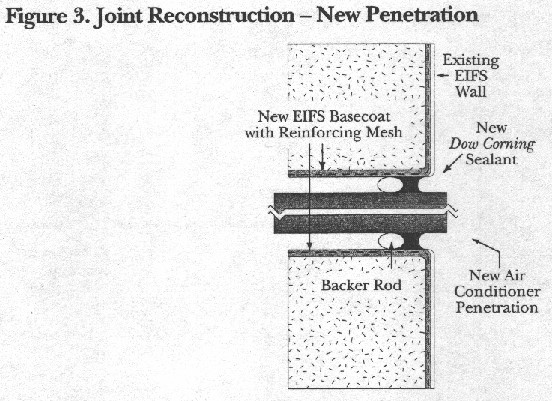
The reconstruction method would be appropriate if joints are sized too small to accommodate joint movement. The use of joint movement indicators can help assess whether joints are of sufficient width for a sealant to perform properly. Joint reconstruction also would be appropriate if a new penetration, such as a window, air conditioner, lighting fixture or other attachment, is being installed (see Figure 3). Joint reconstruction may also be necessary if the original EIFS design did not allow for the proper positioning of an expansion joint. It may be necessary for an EIFS manufacturer or industry consultant to evaluate this condition. In the reconstruction method, the sealant installation is as it would be with a new EIFS installation. Refer to Weatherproofing Sealant Guide for detailed information.
JOINT OVERLAY
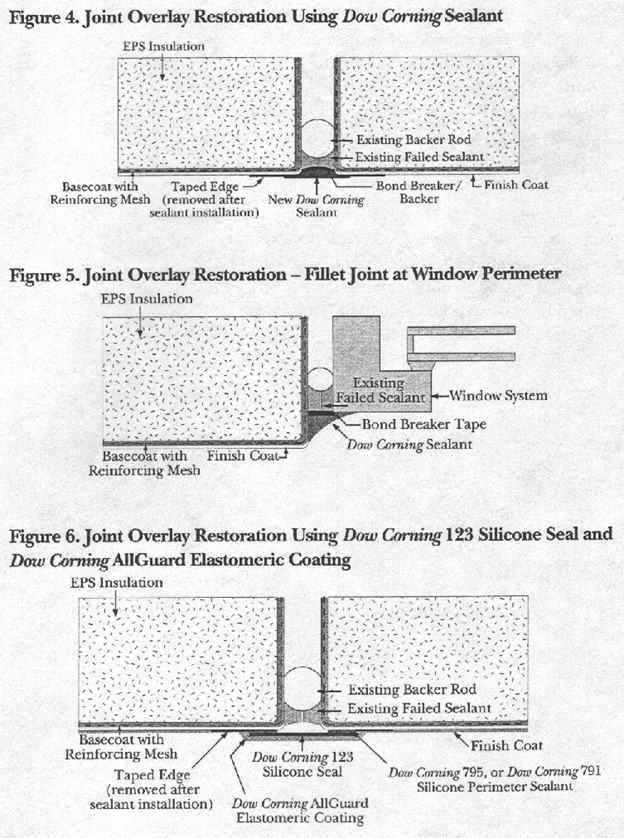
The joint overlay restoration method allows for waterproofing of joints in a cost-effective means that does not require reconstruction of the joint or removal of failed sealant. An overlay joint, commonly referred to as a bridge joint or Band-Aid joint, spans the existing sealant joint from the face of one side of the joint to the other. Traditionally, these joints have been applied in the field with a wet sealant such as Dow Corning 795 Silicone Building Sealant. Field-applied silicone overlay joints have a proven track record of performance on EIFS and other construction materials.
With the introduction of Dow Corning 123 Silicone Seal, the variability of field applied overlay joints has been eliminated. Dow Corning 123 Silicone Seal is the ideal choice for EIFS joint restoration. Dow Corning 123 Silicone Seal can provide a very cost-effective, watertight joint due to the labor savings associated with not having to remove the failed organic sealant. Dow Corning 123 Silicone Seal is applied directly over the failed joint using Dow Corning 795 Silicone Building Sealant as the adhesive. With the assistance of a Dow Corning representative, a field mockup can be installed to demonstrate the performance of this product with your system. When used in conjunction with Dow Corning AllGuard Elastomeric Coating, these Dow Corning products provide a complete silicone solution for failed EIFS joints.
WALL RESTORATION
Restoration of the EIFS wall beyond the existing joints can be complex, requiring the need for a qualified industry consultant who is experienced in EIFS restoration. Provided that the wall is essentially sound, waterproofing and restoring the wall can be accomplished with the use of Dow Corning sealants and Dow Corning AllGuard Elastomeric Coating.
When an EIFS wall is showing hairline cracks of 1/16″ or less, Dow Corning AllGuard Elastomeric Coating can effectively bridge the hairline cracks and waterproof the wall. The Dow Corning AllGuard Application Manual outlines the proper installation for Dow Corning AllGuard Elastomeric Coating on IFS.
In areas where hairline cracks are in excess of 1/16″ width, there may be need for a control or expansion joint at this location. An EIFS expert should be consulted in these cases. If a new joint cannot be installed by the joint reconstruction method, the use of an overlay joint is effective. For an irregular hairline crack, a field-applied wet sealant application with a Dow Corning sealant is recommended. Dow Corning AllGuard Elastomeric Coating than can be applied over the entire wall to ensure a watertight wall should further hairline cracks develop.
EIFS Restoration Procedures
RECESSED JOINT RESTORATION PROCEDURE
This procedure is intended where the existing joints allow for a new sealant joint to be installed over the existing sealant joint. In addition to the procedures outlined below, refer to the Dow Corning Weatherproofing Sealant Guide for more information. Prior to initiating sealant installation, a field adhesion test joint must be installed to verify sealant adhesion in the joint.
- Clean the existing EIFS joint surface using a nonmetallic, stiff-bristle brush. Clean all adjacent metal surfaces with a solvent by the “two cloth” cleaning method. Any residue of the old sealant on the new joint surface must be completely removed. Mechanical abrasion with a wire brush may be necessary to remove old sealant residue. Blow all dust from the joint surface with oil-free compressed air.
- Slit the existing sealant joint and apply a polyethylene or Teflon bond breaker tape over the sealant. The bond breaker tape should be 1/2″ wide or greater depending on the existing joint width. A closed-cell foam bond breaker tape may be necessary to provide a maximum sealant depth of 3/8″ for the tooled sealant.
- Apply an appropriate Dow Corning primer to EIFS and adjacent metal surfaces in a light coat using a soft-bristle brush or lint-free cloth. Avoid applying primer onto adjacent surfaces. Allow primer to dry before installing sealant.
- Install Dow Corning sealant to allow a minimum bond of 1/4″ on the side of the joint. Sealant depth of 1/8″ to 3/8″ at the center of the joint is recommended.
JOINT REMOVAL RESTORATION PROCEDURE
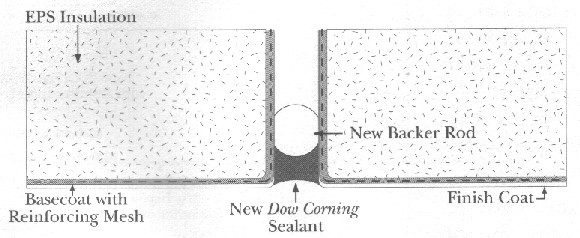
This procedure is best suited where joint failure is the result of finish coat delamination and the existing organic sealant has not reverted. In addition to the procedures outlined below, refer to the Dow Corning Weatherproofing Sealant Guide for more information. Prior to initiating sealant installation, a field adhesion test joint must be installed to verify sealant adhesion in the joint.
- Cut out as much of the existing sealant as possible. Remove and discard the old backer rod.
- Using mechanical abrasion, completely remove all traces of the existing sealant from the EIFS and adjacent metal surfaces. If present, remove the existing finish coat from the inside of the joint. The use of a diamond tipped grinder or mechanical wire wheel abrasion has proven successful for this use. Extreme care must be taken to avoid damaging the existing base coat and reinforcing mesh.
- To remove all dust and loose particles, blow joints with oil-free compressed air. The joints must be thoroughly clean, dry, and frost-free before installing sealant or additional base coat.
- If base coat is damaged, it must be repaired with an appropriate EIFS base coat. An EIFS manufacturer must be consulted for advice in this situation. In most cases, an EIFS manufacturer will recommend a colored primer for use over the base coat.
- After EIFS coatings are allowed to dry, install Dow Corning primer, backer rod, and Dow Corning sealant in accordance with guidelines included in the Dow Corning Weatherproofing Sealant Guide.
JOINT RECONSTRUCTION RESTORATION PROCEDURE
This procedure can be used when replacing a failed sealant joint, widening a joint, adding a new expansion joint, creating a joint through the addition of a new opening in the wall, or creating a new opening for an air conditioner. At all times follow the EIFS manufacturers’ recommendations for the proper installation of their EIFS. This procedure is approved by the EIFS Industry Members Association (EIMA).
- Cut through the EIFS with a sharp knife or saw so that damage to the EPS is minimal. Make this cut approximately 1/4″ to 3/8″ wider than the desired dimension of the new joint so that the sealant can be installed later.
- Remove the unwanted EIFS materials and substrate and repair and damage to the EPS board.
- The existing finish surrounding the new joint must be ground down to base for the space of 4″ to 6″ back from the edge of the joint so that new finish coat can be applied.
- All substrates must be thoroughly dry, dust-free, and frost-free before applying the new coating.
- Apply new base coat to the exposed edge of the EPS board and onto the prepared faces of the wall adjacent to the joint.
- Embed mesh into this new base coat making sure that the EPS board edge is completely protected and the mesh is brought onto the face of the wall where the finish has been removed.
- Apply the EIFS manufacturer’s colored primer to the inside of the joint if required and allow it to dry completely.
- Install the EIFS finish coat to match the existing finish up to the edge of the joint. Due to the difficulty of matching the new finish with the existing, it may be necessary to recoat an entire wall section after modifications have been made. Dow Corning AllGuard Elastomeric Coating can be used in lieu of an EIFS coating to provide a uniform finish and waterproofing of the EIFS wall.
- Install Dow Corning primer, backer rod, and Dow Corning sealant in accordance with guidelines included in the Dow Corning eatherproofing Sealant Guide. Dow Corning AllGuard Elastomeric Coating may be applied directly over cured Dow Corning sealant joints. Install Dow Corning AllGuard Elastomeric Coating in accordance with the Dow Corning AllGuard Installation Manual.
JOINT OVERLAY RESTORATION PROCEDURE
This method is best suited when it is not feasible to remove failed sealant without damaging the EIFS. An overlay joint may be installed with a Dow Corning sealant alone or utilizing Dow Corning 123 Silicone Seal with Dow Corning 795 Silicone Building Sealant, or Dow Corning 791 Silicone Perimeter Sealant as an adhesive. Refer to the Dow Corning Weatherproofing Sealant Guide, Dow Corning AllGuard Installation Manual, and current product literature for more information. Prior to initiating sealant installation, a field adhesion test joint must be installed to verify sealant adhesion in the joint.
- Using a nonmetallic, stiff-bristle brush, abrade the surface of the EIFS finish coat adjacent to the joint. Solvent clean any adjacent metal surface by the “two cloth” cleaning method. Blow all dust from the joint surface with oil-free compressed air.
- Mask the surface of the EIFS to provide a clean edge for the overlay joint.
- Slit the existing sealant joint. Apply a polyethylene or Teflon bond breaker tape over the existing sealant joint only if a wet sealant joint is to be installed. Dow Corning 123 Silicone Seal does not require a bond breaker tape.
- If necessary, as determined through a field adhesion test joint, apply Dow Corning primer to the EIFS surface of the joint. (Dow Corning 790 Silicone Building Sealant typically requires primer on EIFS and metal; Dow Corning 791 Silicone Perimeter Sealant and Dow Corning 795 Silicone Building Sealant typically do not require primer on these substrates.)
- When installing a wet sealant overlay joint, apply and tool sealant in a flat strip or fillet bead over the old joint and onto each side of the joint a minimum of 3/8″. Sealant depth after tooling should be a nominal 1/4″ with a maximum depth of 3/8″. Special plastic tooling devices can be used to provide a uniform joint profile.
- When installing Dow Corning 123 Silicone Seal, select a width that will allow a minimum of 3/8″ bond on each side of the joint. Apply Dow Corning 791 Silicone Perimeter Sealant in approximately 1/4″ diameter beads to each side of the joint. Within 10 minutes of sealant application, press the extrusion onto the sealant using a roller to provide consistent pressure and ensure uniform contact. Remove masking tape and excess sealant.
- Dow Corning AllGuard Elastomeric Coating can be applied directly over any cured Dow Corning sealant or Dow Corning 123 Silicone Seal. Job site adhesion testing should be performed to verify adhesion of Dow Corning AllGuard Elastomeric Coating to the existing EIFS.