
Drawings and Details
Every project has job documents that govern the installation. The job documents usually consist of specifications, drawings, and details. There may also be additional documents that are referred to in the specifications or are used to cover aspects of the job not covered in the specifications. Make sure the information is current.
The following is a front elevation architectural drawing taken from a set of blueprints for a commercial building.
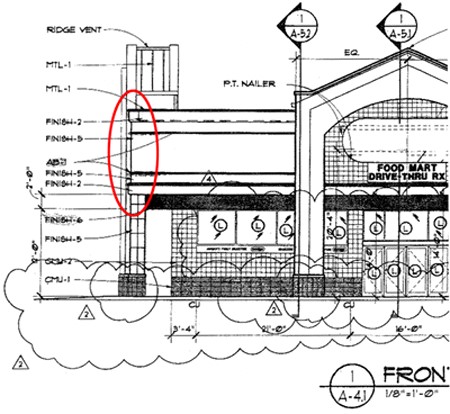
This drawing shows a closer look of the EIFS details to be installed on the building.
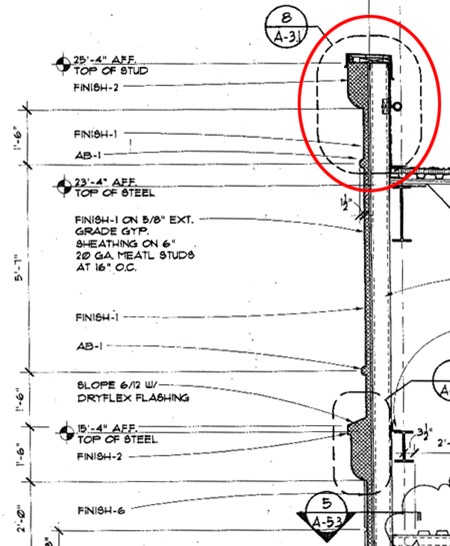
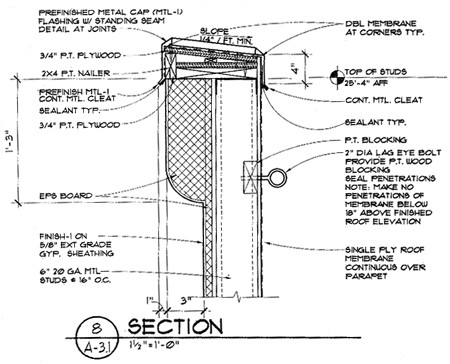
This view shows precise installation instructions for the EIFS detail.
Information Hierarchy
Information regarding a particular installation is available from multiple sources.
- Specific Job or Project Specification, drawings, details and sample panels. The Job Specification often uses a CSI format, often lists several approved manufacturers, states minimum requirements for certain materials and application protocols, and defers to other supporting documents for additional minimum requirements and for specific procedures. The drawings show areas where the system will be used, thickness, locations of reinforced areas, substrates, locations for specific colors and textures, and some detail of terminations and penetrations. The details show specific treatment of terminations, penetrations, and architectural enhancements. The sample panels show the desired textures and colors.
- Manufacturer Specifications and Details. The long form Manufacturer Specifications follows a CSI format that provides specific instructions for system application including: product storage, mixing instruction, weather conditions, cure times, and application procedures. The Manufacturer Details show how they handle terminations, penetrations, and architectural enhancements.
- Model Code Reports. Most of the manufacturers have currently listed Model Code Body Evaluation Reports published by the ICC. Some States, Counties and Cities have their own Code Requirements, and the manufacturer may have a listing electronically or in print for those Jurisdictions.
- Supporting Manufacturer Information. Manufacturers offer supporting information in the form of: Applicator Guides, Tech Notes, Videos, Data Sheets, Bulletins, National Publications, Check Lists and other formats. This information is used to flush-out the core specifications, resolve technical conflicts, provide job tips, and answer common questions. In addition, Manufacturers offer telephone and job site Technical Support.
- Industry Specifications and Details. Industry member associations publish specifications and details that are provided as a guideline and are often generated from a consensus of various sources. Examples of organizations include ASTM, EIMA, and EDI.
- Spec Data Sheets and Master Spec Programs. Spec Data Sheets contain summary information about a manufacturers system and products. They are in a specific CSI format. Master Spec is a computer program and hard copy used largely by architects to compile manufacturer information into a job document.
- General Industry Reference Materials. Non-manufacturer published industry literature.